
Roofing guide
Do I really need a new roof, or will a repair do?
Often a repair will do. Most leaks come from one small failure on a roof with years left, such as a cracked pipe boot, lifted flashing or a few missing shingles. A new roof makes sense when the shingles are worn across whole slopes, leaks show up in several places, or the deck under the shingles has gone soft in several places. This guide covers the rules we use across North Jersey, the signs of a worn-out roof, when one section can be repaired on its own, and what a free inspection with photos shows.
- Registered & insured NJ HIC Reg. #13VH12667100
- Family-owned in Paramus, NJ
- Free written estimates, no obligation
Should I repair or replace my roof? The rules we use
Repair the roof when one detail has failed and the rest of the roof is sound. Replace it when the wear has spread across whole slopes or down to the deck. These are the rules from our roof repair page:
| What we find | Usually the better choice |
|---|---|
| One leak, roof under 15 years old | Repair. The rest of the roof has years left, so the failed detail is fixed. |
| A few shingles blown off in a storm, with the shingles around them still lying flat | Repair. New shingles go in and the area is re-sealed. |
| A leak at a chimney, skylight or wall | Repair. New flashing fixes it, however old the shingles are. |
| Leaks in several places, roof 20 years old or more | Replace. Each repair buys little time. |
| Curling, cracking or bald shingles across whole slopes | Replace. The shingles have reached the end of their life. |
| A soft or sagging deck | Replace. The wood under the shingles has to be opened up and rebuilt. |
The table gives the usual answer, not the answer for every house, which is why we inspect before we recommend either.
Signs you need a new roof, and signs that only look bad
The clearest signs of a worn-out roof are wear across whole slopes, leaks in more than one place and a deck that has gone soft. You can see most of them from the ground or the attic, so please stay off the roof itself.
- Shingles curling, cracking or losing their granules across whole slopes, for example a south slope that is cracked and bald while the north slope holds moss
- Granules washing off into the gutters and piling up below the downspouts
- Leaks in more than one part of the house, or one leak that keeps coming back even after a repair at its source
- Light showing between the roof boards when you look up from the attic, or boards sagging between the rafters
- Shingles torn off across a wide area in a storm
- A second layer of shingles already on top of the first
Some things look alarming but do not on their own mean a new roof. Dark streaks are usually algae, and algae is mostly cosmetic. A ceiling stain, even a dry one, means water got in at least once and the leak probably needs a repair, but one stain does not mean the whole roof is worn out. Age alone decides nothing either: most architectural shingle roofs here last about 20 to 30 years, and our guide to how long a roof lasts in New Jersey explains what moves a roof up or down that range.
When is a roof repair enough?
A repair is enough when one spot has failed and the rest of the roof is sound. If a repair will do the job, that is what we recommend. The usual cases:
- Flashing. Where the roof meets a wall, a dormer, a skylight or a chimney, metal flashing does the waterproofing. Rust, old caulk and poor installation make it leak, and new flashing may address the leak when the surrounding roof and wall materials are sound enough to accept the repair.
- Pipe boots. The rubber collar around a plumbing vent cracks after 10 to 15 years in the sun, often long before the shingles wear out.
- Valleys. Valleys carry the most water on the roof. Debris, worn shingles or a bad cut line let water under, and the fix is a valley repair, not a new roof.
A lasting repair addresses the failed detail with materials suited to the roof. Sealant may be part of a specified repair, but covering a leak with caulk alone does not establish that the underlying problem has been corrected. Every permanent repair comes with a minimum 2-year workmanship warranty on the repaired area, in writing, and some repairs get a longer warranty, depending on the age and condition of the roof. And if the roof as a whole is close to the end of its life, we say so before any repair is made.
Can you replace just a section of a roof?
Yes, if the damage stays in one area of a roof that is otherwise sound. A valley, chimney or dormer wall that failed does not condemn the whole roof, so we repair the section. The same goes for one slope damaged by a falling limb or a gust of wind on a roof under 15 years old.
A section repair can go down to the wood. On our storm repair in West Orange, a tree had come through the roof: the damaged decking was cut out and replaced, and the damaged shingles were replaced across the slope. We match new shingles to the brand, style and color of the old ones as closely as we can. Because shingles fade with age, the repaired area can look a little newer at first, and it blends in over time.
A section repair makes sense only on a roof with years left. When leaks occur in several places on a worn roof, a local repair may leave other defects unresolved. We assess the wider condition before recommending that you keep paying for individual repairs.
When is it time to replace the roof?
It is time when the wear is everywhere rather than in one spot, as in the three Replace rows of the table above, and then the money is better spent on a new roof. Two layers of shingles already on the house point the same way.
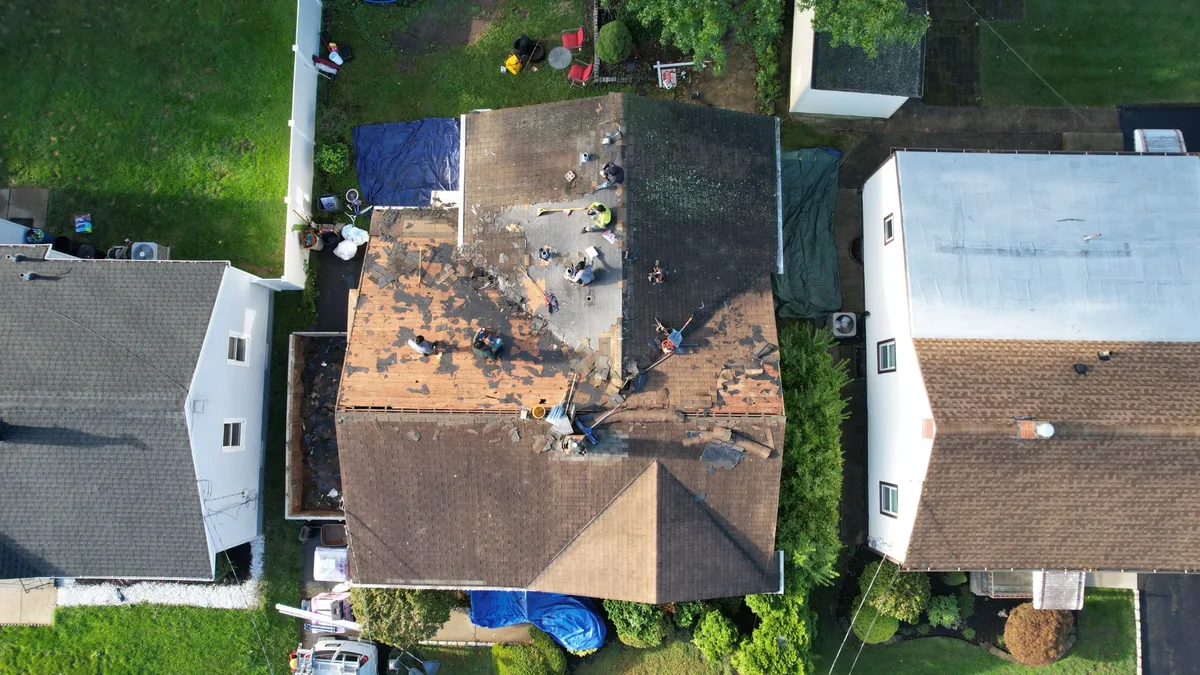
A roof replacement starts with a full tear-off down to the wood deck, because nobody can tell how much of the deck needs replacing until the old roof is off. Rotted or delaminated wood is replaced so the nails hold, and when we find rotted wood, we stop, take photos and show you. The new roof is finished with architectural shingles from Owens Corning or GAF, or another brand if you have a preference, and our guide to what a full roof replacement should include goes through every layer.
Flat sections and slate have their own signs. A flat roof on a house can be repaired while the membrane is in fair shape and the insulation under it is dry. Once the insulation is soaked, the membrane has gone brittle or leaks are everywhere, it needs replacing. On slate, flashing and old nails wear out long before the stone. Replacement usually makes more sense than repair once the slate has gone soft or flaky and around one in five slates is broken or delaminating.
Should I replace my roof if it is not leaking?
Sometimes, yes. A roof does not have to leak to be worn out, so look at its condition rather than the ceilings. Worn shingles across whole slopes, granules piling up in the gutters or a soft deck are reasons to plan a new roof before it leaks. Once water gets in, it soaks the insulation and decking, where mold and rot grow out of sight.
Timing matters both ways. Replace too early and you give up years the old roof still had. Wait too long and water reaches the deck, the insulation and the ceilings. If your roof is 20 years old or more, or you do not know its age, have it checked.
A roofer says I need a new roof. Should I get a second opinion?
Yes, if the advice is not backed by photos. A roofer who says you need a new roof should be able to show you the signs above in photos. If the photos show one failed flashing, a cracked pipe boot or a few lost shingles, that is usually a repair, and a second opinion is worth having before you agree to a new roof.
On a slate roof, get a second opinion before you agree to a tear-off: many roofers do not work with slate and recommend tearing it off because shingles are what they know. For our part, we will tell you which one you need and show you the photos that back it up.
What a free roof inspection shows
An inspection settles the question with evidence. We start in the attic when we can and follow any stain back to its source, then check the roof above it: the shingles, the flashing, the vents and pipe boots and anything else that goes through the roof, plus the gutters. We photograph what we find.
Then we show you the photos and tell you what we would do if it were our house. You get a written estimate that names the scope and the materials, and where a repair and a new roof both make sense, it covers both so you can choose. The estimate is free, with no obligation.
If water is coming in right now, the decision can wait. Stay off the roof, catch the water inside and call us, and see emergency roof repair for what to do in the meantime.
Two scopes you can compare
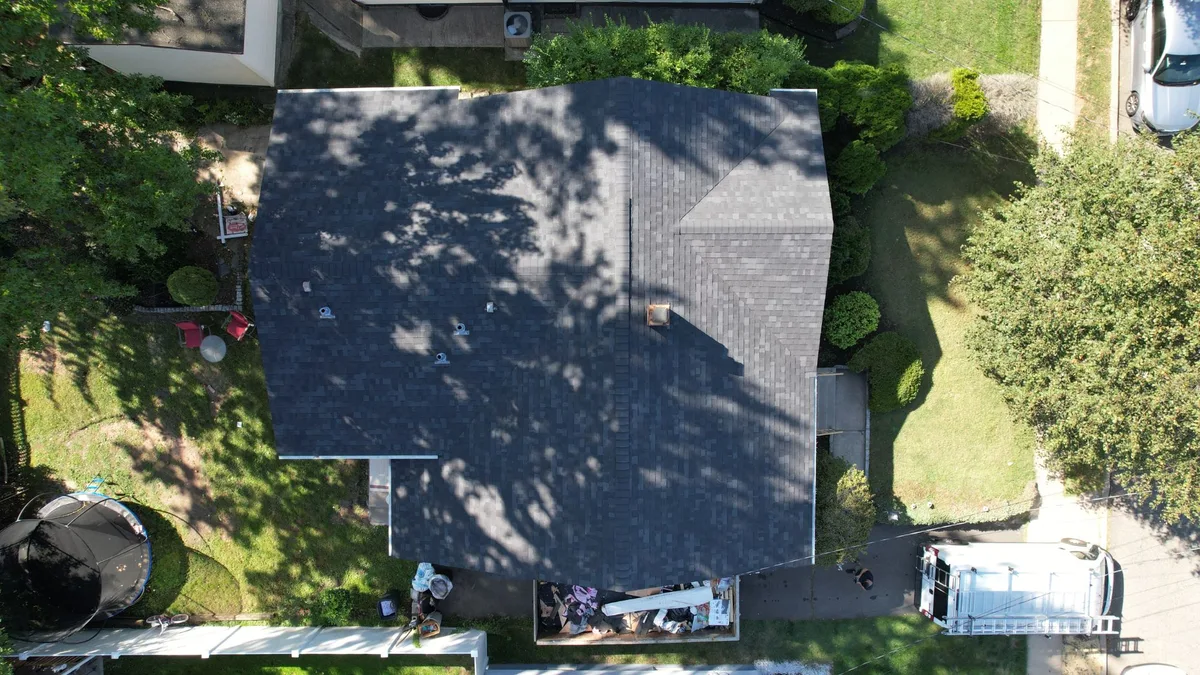
Our Mahwah flashing repair focuses on the connection between a shingle roof and siding. Our Mahwah roof replacement documents a much broader job. Looking at both helps you ask what is being repaired, what is being replaced and what condition remains outside the proposed scope.
Before agreeing to work, ask for photos of the problem, the reason for the recommended scope, the materials, the handling of concealed deck damage and the written warranty terms. A roof’s age is one factor; it does not replace inspection of the actual condition.
Owner involvement: Ervin brings 12 years of roofing experience to ProTech. He handles sales and most initial roof inspections, works with a project manager, and personally inspects projects during the work and after completion. Meet Ervin.
Questions
Repair or replace: common questions
Is it worth repairing an old roof?
It depends on how much of the roof is worn out, more than on its age. Failed flashing at a chimney, skylight or wall can be fixed on a roof of any age, and a cracked pipe boot is a simple fix. Once the shingles are curling, cracking or bald across whole slopes and leaks show up in several places, a new roof is the better buy. A free inspection, with photos of what we find, shows whether yours is worth repairing.
How many leaks before a roof should be replaced?
There is no set number. On a roof 20 years old or more, leaks in several places usually mean it is time for a new roof. A leak that keeps coming back in one spot is a warning sign too, but have the source checked first: water often drips several feet from where it gets in, and a patch on the wrong spot does not stop it.
Will a new roof stop a leak around a chimney or skylight?
Only if the flashing is new too, and at a skylight only if the unit itself is sound. At a chimney the metal flashing is the usual cause, and at a skylight it is almost always the flashing or a worn-out unit. On an otherwise sound roof, the fix is new flashing, or a new skylight if the unit is worn out, not a new roof. When a new roof does go on, the flashing should be replaced as well, because old flashing under new shingles is the most common cause of leaks on a new roof.
Do dark streaks on a roof mean it needs replacing?
Not by themselves. Dark streaks are usually algae, which grows on the limestone filler in shingles, mostly on shaded slopes, and is largely a cosmetic problem. Judge the roof by the shingles under the streaks: if they still lie flat and hold their granules, the streaks are no reason to replace it. If you do get a new roof, algae-resistant shingles slow the streaks down for years.
Does a roof with two layers of shingles need replacing?
Not always, but having two layers on the house is one of the signs that a repair may not be enough. A second layer hides the condition of the deck, adds weight and traps heat, which shortens the life of the shingles on top. When a layered roof is replaced, both layers come off down to the wood deck, so every board can be checked and the bad ones replaced before the new roof goes on.
Not sure if you need a new roof?
If you are not sure whether your roof needs a repair or a new roof, call us or ask for a free inspection, and you will get photos of what we find and a written estimate that explains your options.