
Roofing guide
Why does my roof leak only in heavy rain or wind?
A roof that stays dry in a light rain but leaks in a downpour or a windy storm usually has one weak detail that only hard or sideways rain can reach. The usual spots are valleys, the flashing at walls, dormers, chimneys and skylights, pipe boots and shingles the wind has lifted. This guide explains why these leaks come and go, what to note for your roofer and how ProTech Roofing finds and fixes them on North Jersey homes.
- Registered & insured NJ HIC Reg. #13VH12667100
- Family-owned in Paramus, NJ
- Free written estimates, no obligation
Why does a roof leak only when it rains hard?
Because heavy or wind-driven rain gets water to parts of the roof that an ordinary rain leaves dry. A roof keeps water out with overlaps: each course of shingles laps over the one below, and at walls, chimneys and skylights, metal flashing is woven into the shingles and turned up against them. In a light rain, water simply runs over those laps and off the roof.
Heavy rain can overwhelm old flashing, and in a valley packed with leaves the water backs up and runs sideways under the shingles. Wind drives rain sideways into flashing and under lifted shingle edges. The weak spot is there in every rain, but it takes a certain kind of storm to reach it.
So a dried-out stain does not mean the roof has healed. The opening is still there for the next storm of the same kind, and wet insulation and decking can grow mold and rot where no one sees them. The stain is rarely right under the opening, either, because water can travel down the roof boards or along a rafter or pipe for several feet before it drips.
Roof only leaks when it is windy: wind-driven rain and lifted shingles
A leak that shows up only in windy storms usually means rain is being driven sideways into a spot that ordinary rain never reaches. In North Jersey that mostly means nor’easters and summer thunderstorms. Their wind lifts and tears shingles, peels back flashing and pushes water behind flashing that is loose, too short or only held on with caulk.
Shingles are sealed down to the course below, and wind breaks that seal. A lifted shingle lets wind-driven rain under it even before anything blows off. So when we replace missing or lifted shingles with matching ones, we also check the surrounding courses for loose nails, not only the gap.
The direction of the storm matters too. A storm out of the northeast pushes water into the walls, chimney sides and skylight edges that face it, while a gentle rain from another direction leaves them dry. If the ceiling stains only in certain storms, we check the flashing on the side of the house that faces the wind first.
Roof valley leaking in heavy rain
Valleys carry the most water on the roof, which makes them a common source of leaks that show up only in a downpour. A valley is the channel where two slopes meet, and in heavy rain it takes the runoff from both. When debris builds up, the shingles wear thin or the valley line was cut badly, that water gets under the shingles. Under trees, wet leaves pack into valleys and hold water against them.
On a shingle roof we repair the leaking part of the valley with matching shingles and replace any rotted decking under it. On a slate roof, the slates are lifted, new copper flashing goes in and the slates go back.
Some heavy-rain water problems start at the roof edge instead. Where a valley empties onto one spot of a clogged or undersized gutter, water spills over the front or, without a gutter apron, runs behind the gutter. For valleys that dump into one spot, we recommend 6-inch seamless gutters, which hold roughly 40 percent more water than 5-inch ones.
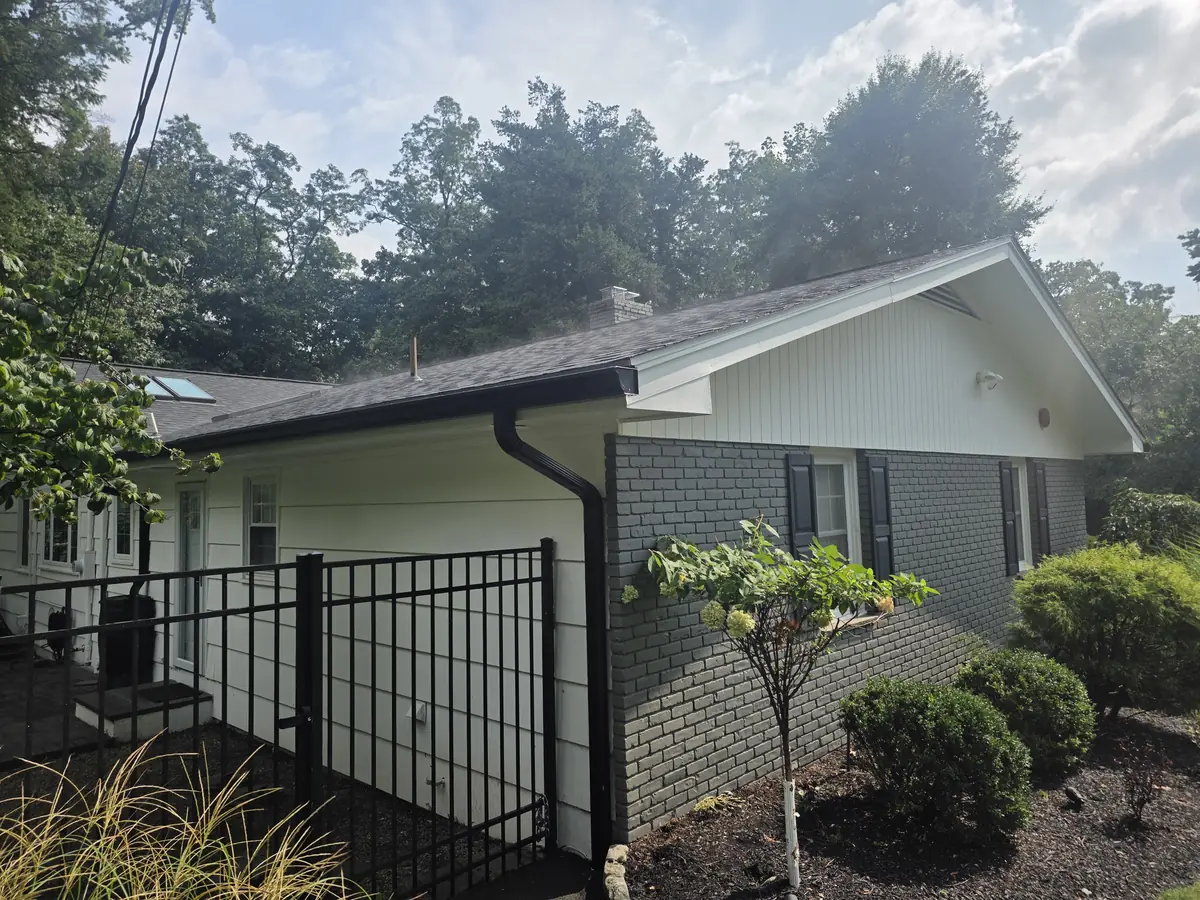
Leak where the roof meets a wall or dormer
A leak where the roof meets a wall or a dormer usually comes from the flashing. Step flashing is a row of L-shaped metal pieces woven into each course of shingles and turned up the wall, and at a stucco or brick wall, counter-flashing laps down over it. Rust, old caulk and bad installs make it leak, and a heavy or wind-driven rain running down the wall finds gaps that a light rain runs past.
On larger, newer homes we have found step flashing caulked instead of woven in. On one house the roof ran into a stucco wall with no flashing of any kind. That roof got new shingles with 5 by 5 by 8 inch step flashing, new counter-flashing and custom flashing under the shingles where the lower and upper roofs meet. On a dormer wall we used the same size, because bigger pieces give more coverage where water runs down the wall.
Low roofs over porches, additions and garages leak at the wall line too, and a slope too flat for shingles makes it worse. Our guide to porch and addition roof leaks explains those roofs.

Chimney, skylight or vent pipe leaking when it rains hard
When a chimney, a skylight or a plumbing vent leaks only in hard rain, the flashing or the rubber pipe boot around it is usually the reason.
- Chimney flashing. The chimney is the most common place for a roof to leak. A shortcut we often find is flashing only stuck on with roof cement or caulk, which stays dry until the sealant cracks. A leak that comes only in wind-driven rain usually points to counter-flashing that is loose or too short. A wide chimney also needs a cricket, a small peaked roof behind it that splits the water around the sides. See chimney flashing repair.
- Skylights. When the drywall around a skylight stains after rain, the flashing has usually failed or was badly installed. Drips from the glass or frame only in cold weather are usually condensation from humid indoor air, not a leak. See skylight repair.
- Pipe boots. A pipe boot is the rubber collar that seals around a plumbing vent, and it cracks after 10 to 15 years in the sun. It is one of the most common roof leaks, and a new pipe boot flashed into the shingles fixes it.

What to tell your roofer about a leak that comes and goes
The weather that brings the leak is the most useful clue you can give a roofer, so write it down each time. Note:
- Which storms bring it: every hard rain, or only rain with strong wind.
- Which way the wind was blowing, and which side of the house faces it.
- Where the water shows up: which room, and how close to an outside wall, a chimney, a skylight or a vent pipe.
- Whether it ever drips in cold weather with no rain. That is more likely condensation.
- Photos of the stain, and of anything you can see from the ground, such as shingles in the yard.
Stay off the roof, which is dangerous when wet or damaged. If water is coming through the ceiling now, our guide to water coming through the ceiling and our emergency roof repair page list what to do inside the house.
How we find a leak that only shows in some storms
In three steps: we follow the water from the attic to the roof, check for hidden moisture with an infrared scan, then test the likely spots with a hose. Where there is attic access, we trace the stain to the point where water enters, then check the roof above it: flashing, nail pops, shingle condition and everything that comes through the roof. The storms you noted tell us which side of the house and which details to check first.
A leak that needs a certain storm may not show on a dry day, so we run the hose over one suspect area at a time, with someone inside watching for the first drip. That way the repair goes where the water gets in, not where it shows. You get photos of what we find and a free written estimate.
That step matters, because a patch made at the stain instead of the source is a common reason a roof is still leaking after a repair.
What the fix usually is: new flashing, not more caulk
Usually new metal flashing or matching shingles at the one detail that failed, not more caulk, and in most cases not a new roof. Most of these leaks are one failed spot on a roof with years left. Where a chimney, skylight or wall is leaking, new flashing solves it, whatever the age of the shingles. Lifted or missing shingles and leaking valleys get matching shingles, and a cracked pipe boot is replaced.
Sealant alone fails in a season or two, so the repair uses new metal. At a chimney, the old flashing and roof cement come off, new step flashing goes in course by course with the shingles, and new counter-flashing sits in a groove cut between the bricks and folds down over it. A leaking skylight gets a full re-flash with the shingles around it replaced, or a new unit if it is worn out.
Every permanent repair comes with a minimum 2-year workmanship warranty on the repaired area, in writing, and some repairs get a longer warranty, depending on the age and condition of the roof. If the roof leaks in several places and is 20 or more years old, a new roof is usually the better buy, and we say so before you pay for a repair. Our guide to whether you need a new roof or a repair goes further. See roof repair and roof replacement.
Questions
Heavy rain and wind leaks: common questions
Can you find a roof leak when it is not raining?
Usually, yes. The attic shows the path the water took, so on a dry day we can still follow it back to the spot where it enters and check the roof there. An infrared scan can also show moisture that is hidden from view. If a leak only shows in certain storms, we test one likely spot after another with a garden hose while a helper in the house waits for the drip. Telling us which storms bring the leak helps us pick where to start.
Why does my roof leak in the wind when no shingles are missing?
Wind does not have to tear shingles off to let water in. It can break the seal on shingles and lift them, peel back flashing, and force rain in behind flashing that has worked loose, was cut too short or is held in place only by caulk. Storms also expose flashing that was already on its way out. We check the shingles around the leak for loose nails and lifted edges, and replace any flashing that has failed.
Will caulk stop a leak that only shows up in heavy rain?
Not for long. Caulk is a temporary patch, and the leak tends to come back in the next storm of the same kind. Flashing held on with caulk at a chimney, wall or skylight is often the cause of the leak in the first place. The lasting fix is new metal flashing woven into the shingles. Please do not go up on the roof yourself.
Can clogged gutters cause a leak in heavy rain?
They can. A gutter that is clogged, undersized or pitched wrong overflows in a hard rain, and the water ends up in the fascia, the soffit or the basement instead of the downspout. Peeling paint or soft, rotted wood on the fascia and soffit, or water in the basement below one gutter run, are the signs. An inspection covers the roof surface, flashing, vents, gutters and attic, with photos, so you can see whether the water comes from the roof or the gutters.
Do I need a new roof if it only leaks in heavy storms?
Usually not. A leak that comes only in hard or windy rain is most often one failed detail, such as a valley, a pipe boot or the flashing at a chimney, skylight or wall. Each of those can be repaired on its own, and new flashing fixes a flashing leak no matter how old the shingles are. A new roof makes sense once the roof is 20 years old or more and leaking in several spots, or the shingles are curled, cracked or bald on whole slopes. A free inspection with photos tells you which one your roof needs.
Roof leaking only in some storms?
If your roof leaks only in heavy rain or wind, call us or ask for a free inspection, and tell us which storms bring it so we can trace the leak and show you photos of what we find.