
Roofing guide
What a full roof replacement should include
A full roof replacement is more than new shingles. It should include a tear-off to the deck, new wood where the deck is bad, drip edge, ice and water barrier, synthetic underlayment, new flashing, attic ventilation and a proper clean-up. This guide goes through each part, when skylights and gutters belong in the job, and how to compare written estimates line by line.
- Registered & insured NJ HIC Reg. #13VH12667100
- Family-owned in Paramus, NJ
- Free written estimates, no obligation
What is included in a roof replacement?
Everything from the wood deck up, not only new shingles. A new roof is a system of layers, and each one has a job. This is what every ProTech roof replacement on North Jersey homes includes, from the tear-off to the paperwork:
- Tear-off. The old roofing comes off, down to the wood deck.
- Deck inspection and repair. Rotted or delaminated boards and plywood are replaced so nails hold.
- Drip edge at the eaves and rakes, to keep water off the fascia.
- Ice and water barrier at the eaves, in valleys and around chimneys, skylights and pipes.
- Synthetic underlayment over the rest of the deck.
- Starter strip and architectural shingles, nailed to the manufacturer’s pattern.
- New flashing at walls, chimneys and pipes.
- Ridge vent and hip and ridge caps, so the attic can breathe.
- Clean-up, a magnet sweep for nails and finished photos of your roof.
- Minimum 15-year workmanship warranty in writing, longer depending on the roofing product, plus the manufacturer’s limited warranty on the shingles.
Skylights and gutters are separate choices, covered further down.
Does a roof replacement include new plywood?
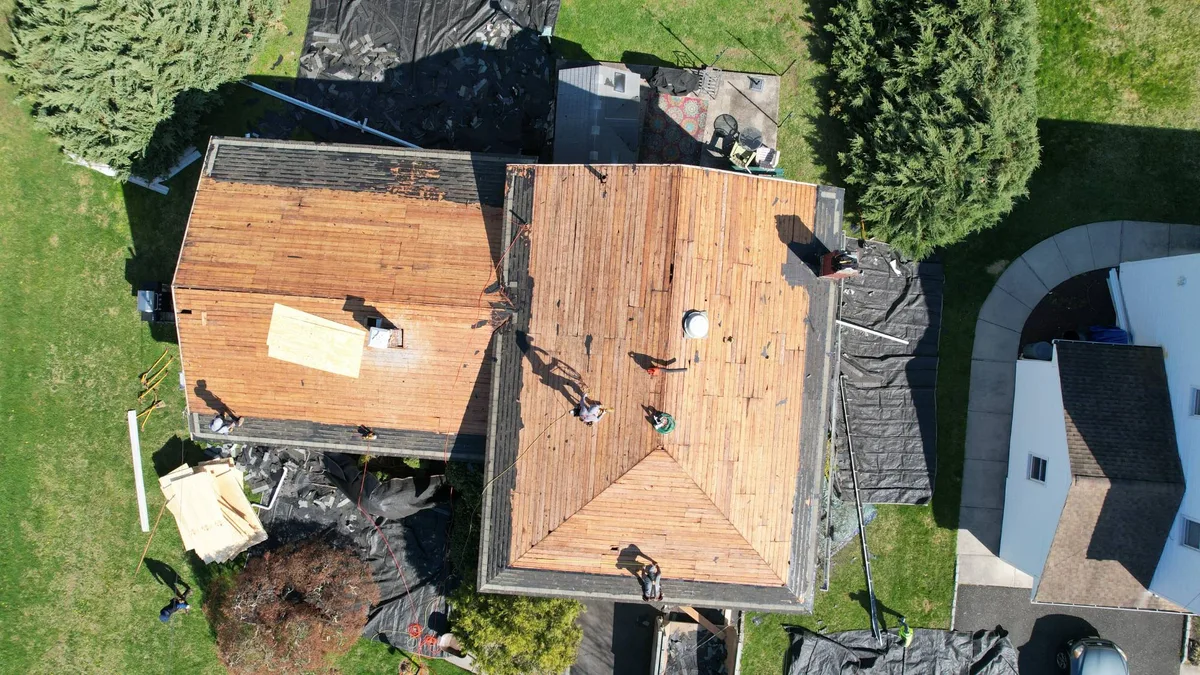
Yes, wherever the old wood needs it. A full tear-off strips the old roofing down to the wood deck, so every board can be checked, and rotted or delaminated boards and plywood are replaced. Shingles nailed into bad wood do not hold.
That is also why we do not recommend laying new shingles over old ones. A second layer hides rotted decking, adds weight, traps heat and shortens the life of the new shingles.
How much wood a roof needs depends on the house. Many 1920s to 1940s colonials and Tudors here have old plank decking, sometimes under a second or third layer of shingles. Planks shrink and leave gaps, and new shingles need solid decking under them. Some roofs need a few sheets of plywood, some a whole new deck.
No one can know how much wood needs replacing until the old roof is off. When we find bad wood, we stop, take photos and show you before it is replaced.
What goes under the shingles: drip edge, ice and water barrier and underlayment
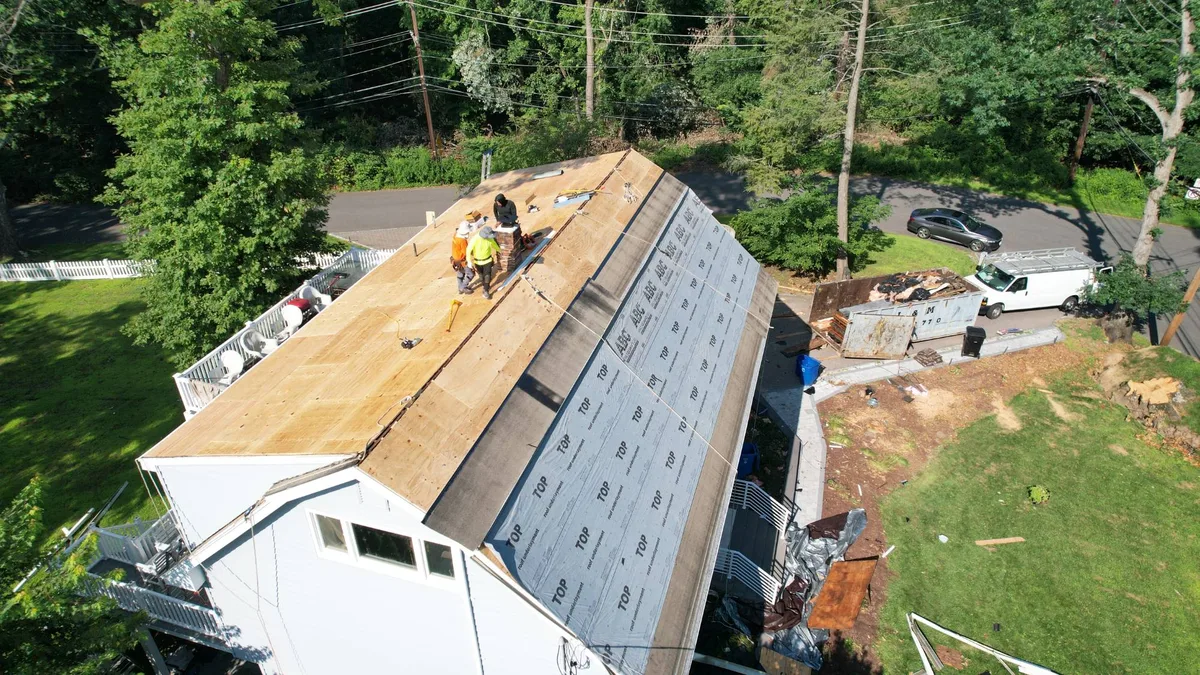
Three things go down on the bare deck before the first shingle, and each protects a different part of the roof.
- Drip edge. Metal edging at the eaves and rakes keeps water off the fascia. At the eaves, drip edge and gutter apron send water into the gutter, not behind it.
- Ice and water barrier. This self-adhered membrane goes at the eaves, in the valleys, where two slopes meet and the most water runs, and around chimneys, skylights and pipes, where the roof is cut open.
- Synthetic underlayment. The rest of the deck gets synthetic underlayment, which holds up far better than old felt paper, as a second layer of protection under the shingles.
An estimate should name all three and say where the barrier goes. One that names only the shingles leaves out the layers that keep water out when a shingle lifts in a storm.
Architectural shingles, starter strip and hip and ridge caps
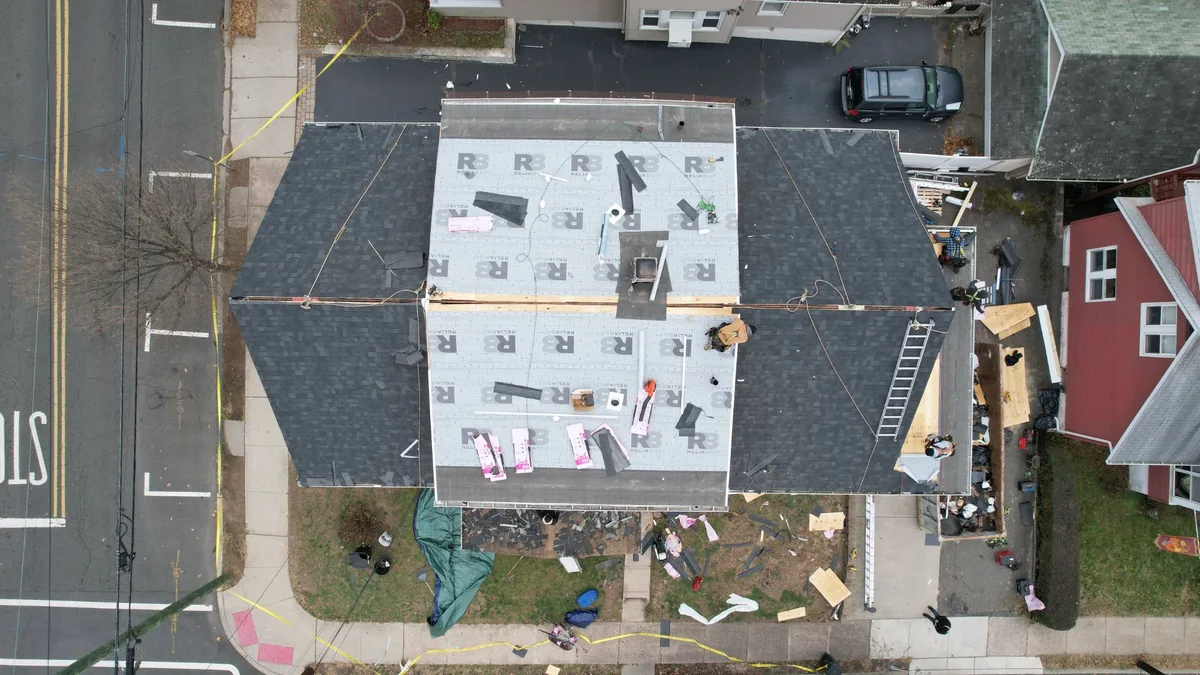
The shingle layer has three parts: a starter strip along the edges so the first course seals against wind, the architectural shingles, nailed to the manufacturer’s pattern, and matching hip and ridge caps along the hips and the peak.
We install architectural shingles from Owens Corning and GAF, and other brands if you have a preference. Compared with the old three-tab kind, they are thicker and rated for higher winds.
- Owens Corning Duration series shingles have a reinforced SureNail nailing strip and 130 MPH wind warranty coverage.
- GAF Timberline HDZ shingles use the LayerLock system with a wide nailing zone.
- Both lines offer algae-resistant options, which helps on shaded, tree-covered lots.
How the shingles are put on matters more than the brand on the bundle. A wide nailing zone means more nails land where they should, and those nails need solid wood to grip, which is why the deck work comes first. Our guide to roof life in New Jersey covers how long a new shingle roof lasts here.
Does a roof replacement include new flashing?
It should, and on every ProTech roof replacement it does. We install new flashing at walls, chimneys and pipes and do not reuse worn-out flashing, because old flashing under new shingles is the most common cause of leaks on a new roof.
- Walls and chimneys. Step flashing is woven into each course of shingles and turned up against the wall or the brick. At a chimney, new counter-flashing is set into a groove cut between the bricks and laps down over the step flashing.
- Crickets. Behind a wide chimney, a cricket, a small peaked roof, splits the water and sends it around the sides. We build one when we re-flash a chimney that needs it.
- Pipes and vents. Pipe boot collars are rubber, and the sun cracks them after 10 to 15 years, so new pipe boots go on with the new shingles.
Flashing held to the brick only by roof cement or caulk is a shortcut: it lasts until the sealant cracks, and then the leak starts. If an estimate says the old flashing will be reused or sealed, ask why.
Roof ventilation on a new roof
Ventilation is part of the roof, not an extra. An attic that traps heat and damp air wears the shingles out from underneath. So on every ProTech roof replacement, the intake at the soffits and the exhaust at the ridge are checked, and anything that falls short is corrected as part of the job.
Balanced ventilation means air comes in low, through the soffits, and leaves high, through a ridge vent along the peak, which the ridge caps then cover. This matters most on the 1950s and 60s Cape Cods, ranches and split-levels common in North Jersey, which tend to have low attics with little ventilation. Your estimate should name the ventilation work at the ridge and at the soffits.
Should you replace skylights and gutters with a new roof?
Skylights, usually yes. Gutters, only if they are worn out or too small for the roof.
Skylights. Skylight makers put the service life of a good unit at roughly 20 to 30 years. If your skylights are 15 years old or more and you are getting a new roof, replace them now. The shingles around them are already off, the new flashing ties into the new underlayment and shingles as one system, and replacing a skylight later means cutting into the new roof. A skylight you keep is re-flashed with the new roof, with new barrier around the opening and a new flashing kit. We check every skylight during a roof replacement estimate and list it as a separate line, so the choice is yours.
Gutters. If your gutters are in good shape, we work around them and clean them out at the end of the job. If they are old or undersized, or they sag, pull away, rust through or drip at the seams, replacing them with the roof saves a second set-up and lets us install the drip edge, gutter apron and new seamless gutters as one system. Rotted fascia behind an old gutter gets replaced, because a gutter is only as strong as what it is screwed into.
What should be included in a roof replacement estimate?
Every item on the list above, with the materials named, so you can compare it line by line with any other estimate. With two or three estimates side by side, check each one for:
- A full tear-off to the deck, and how many layers come off.
- How bad wood is handled, with photos before it is replaced.
- Drip edge, synthetic underlayment, and where the ice and water barrier goes.
- The shingle by brand, line and color, such as Owens Corning Duration or GAF Timberline HDZ.
- New flashing at walls, chimneys and pipes, with a cricket where a wide chimney needs one.
- The ventilation work at the ridge and the soffits.
- Skylights and gutters as separate lines.
- Clean-up, including a magnet sweep for nails.
An estimate that says only new shingles, with no materials named, leaves all of that open.
A ProTech written estimate itemizes the scope, underlayment and ice and water barrier, flashing, ventilation, any decking replaced and clean-up, and names the exact shingle and color. We protect plants, AC units, walkways and driveways during the work, and at the end we haul everything away and review the job with you.
The estimate comes after a free inspection with photos of what we find. If a repair will do the job, that is what we recommend, and our guide to repair or replace explains how to tell. See roof replacement for how we build a new roof.
Questions
Roof replacement: common questions
Do roofers replace plywood when they put on a new roof?
Where the old wood needs it. After the tear-off, every board is checked, and rotted or delaminated boards and plywood are replaced so the nails hold. Older homes with plank decking may need solid decking under the new shingles, because planks shrink and leave gaps. Nobody can tell how much wood a roof needs until the old roofing is off, so ask to see photos of any bad wood before it is replaced.
Can a new roof go over the old shingles?
We do not recommend it. Every ProTech roof replacement strips the old roofing down to the wood deck, because a second layer hides rotted decking, adds weight, traps heat and shortens the life of the new shingles. With the old roof off, every board can be checked, bad wood is replaced, and the barrier, underlayment and flashing go down on a sound deck.
Should skylights be replaced with a new roof?
Usually, yes, once a skylight is about 15 years old. Skylight makers expect a good unit to last roughly 20 to 30 years, so an older one is likely to give out before the new shingles around it do. Replacing it with the roof avoids cutting into new shingles later. A skylight you keep gets new flashing and barrier with the new roof. Each one is a separate line on our estimate, so you decide.
Is attic ventilation part of a roof replacement?
It should be. Heat and moisture in a poorly ventilated attic cook shingles from below and shorten the life of a new roof. That is why we check the intake at the soffits and the exhaust at the ridge with every new roof, correct what needs it, and finish the peak with a ridge vent under matching ridge caps. Low attics on older Cape Cods, ranches and split-levels need this most.
What should a roof replacement estimate include?
The full scope and the materials by name: tear-off to the deck, how bad wood is replaced, drip edge, where the ice and water barrier goes, the underlayment, the shingle brand, line and color, new flashing, ventilation, any skylights or gutters as separate lines, and clean-up. With those in writing, you can compare estimates line by line.
Planning a new roof?
If you are planning a new roof, call us or ask for a free written estimate that lists the scope and the materials by name, with photos of what we find.